Which Year Groups Borrow the Most Audiobooks? 2026 Data
By ePlatform Collection Management
| Jul 08, 2569
Categories : Learn about Audiobooks
Published: 8 July 2026 | Last updated: 31 August 2026 | Data period: January to June 2026
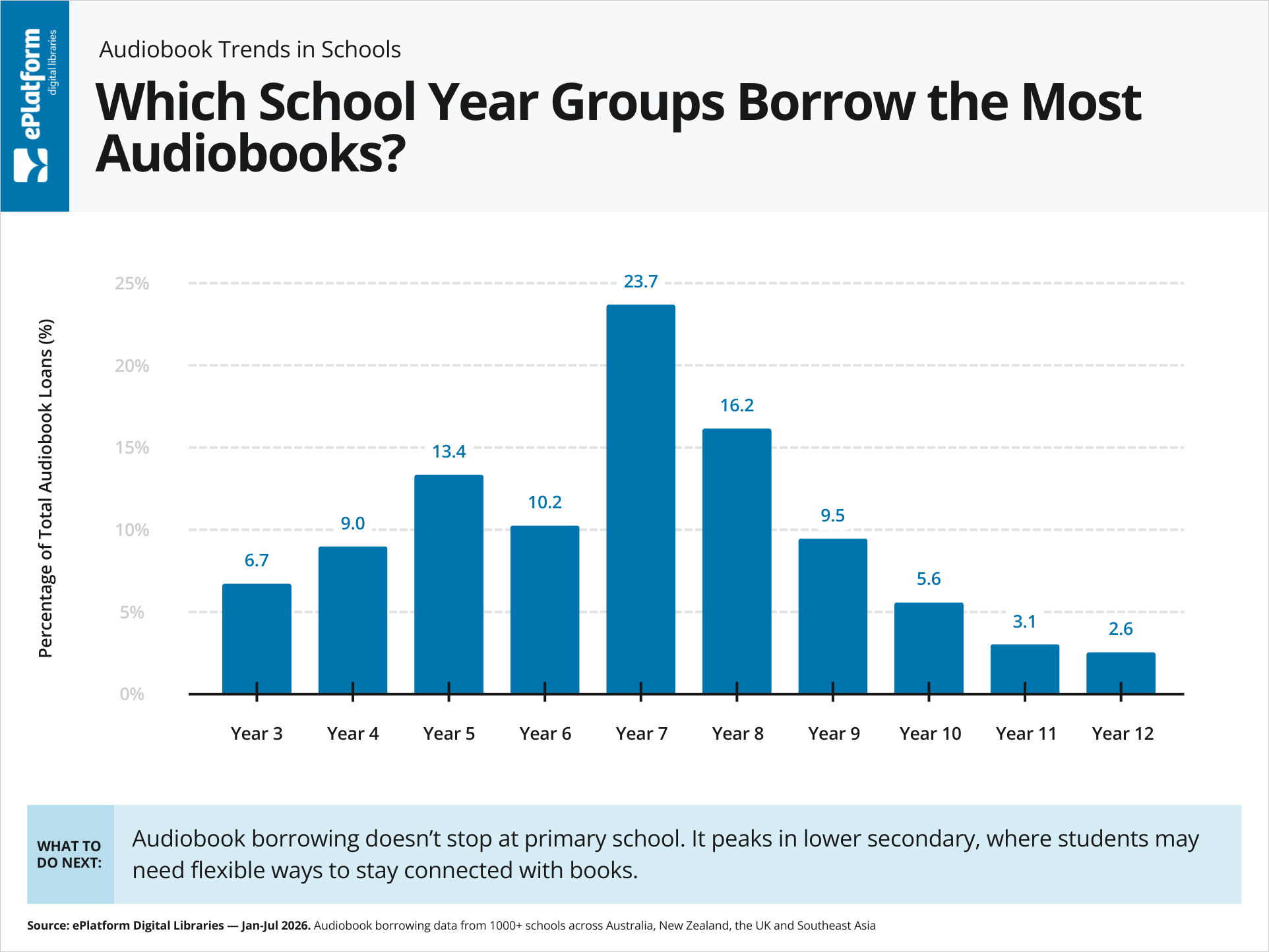
Year 7 recorded the largest share of audiobook borrowing in ePlatform’s 2026 data. Among audiobook loans assigned to students in Years 3 to 12, Year 7 accounted for 23.7 percent, followed by Year 8 at 16.2 percent and Year 5 at 13.4 percent.
Years 7 to 9 collectively accounted for 49.4 percent of the audiobook loans included in the analysis. This makes the early secondary years the strongest borrowing stage in the dataset and shows that school audiobook use is not limited to primary students.
The results measure each year group’s share of total audiobook loans. They do not measure borrowing per student, listening time, completed audiobooks or the number of unique students who borrowed.
In this article
Audiobook Borrowing Statistics by School Year Group
Year 7 recorded the highest share of audiobook loans, accounting for 23.7 percent of the borrowing included in the study. This was substantially higher than every other year level.
Year 8 ranked second with 16.2 percent, while Year 5 ranked third with 13.4 percent. Together, Year 7 and Year 8 accounted for 39.9 percent of audiobook loans across the included year levels.
The full percentage distribution is shown below. Presenting the results as shares makes it possible to compare borrowing patterns without using absolute platform loan totals.
| School year group | Share of audiobook loans | Borrowing rank |
|---|---|---|
| Year 3 | 6.7% | 7 |
| Year 4 | 9.0% | 6 |
| Year 5 | 13.4% | 3 |
| Year 6 | 10.2% | 4 |
| Year 7 | 23.7% | 1 |
| Year 8 | 16.2% | 2 |
| Year 9 | 9.5% | 5 |
| Year 10 | 5.6% | 8 |
| Year 11 | 3.1% | 9 |
| Year 12 | 2.6% | 10 |
| All included year groups | 100% |
Source: ePlatform Digital Libraries. Percentages represent each year group’s share of audiobook loans assigned to Years 3 to 12 during the study period.
Audiobook Use in Primary and Secondary Schools
Do secondary school students use audiobooks? The borrowing data clearly shows that they do.
Among the year levels included in the analysis, Years 7 to 12 accounted for 60.7 percent of audiobook loans. Years 3 to 6 accounted for the remaining 39.3 percent.
This does not provide a complete primary versus secondary comparison because the dataset begins at Year 3. Earlier primary year levels were not included. It does, however, show that the majority of loans in the filtered dataset came from secondary year levels.
Breaking the data into three school stages provides a clearer view of the pattern:
| Year-level group | Share of audiobook loans |
|---|---|
| Years 3 to 6 | 39.3% |
| Years 7 to 9 | 49.4% |
| Years 10 to 12 | 11.3% |
Years 7 to 9 formed the largest borrowing stage, accounting for almost half of the loans included in the analysis. By comparison, the senior secondary years accounted for a much smaller share.
For a broader introduction to using audio in education, read our guide to audiobooks for schools.
How Does Audiobook Borrowing Change Across School Year Levels?
Audiobook borrowing did not move in a straight line as students progressed through school. Instead, the data showed several distinct stages.
Audiobook borrowing increased from Year 3 to Year 5
The share of loans rose from 6.7 percent in Year 3 to 9.0 percent in Year 4 and 13.4 percent in Year 5. Year 5 was the strongest primary year group included in the analysis.
Borrowing dipped in Year 6 and peaked in Year 7
Year 6 accounted for 10.2 percent of loans before the share increased sharply to 23.7 percent in Year 7. This made Year 7 the clearest peak in the data.
Audiobook borrowing declined after Year 8
Year 8 remained a strong borrowing year with a 16.2 percent share. From Year 9 onwards, the share decreased at every year level, reaching 2.6 percent in Year 12.
This pattern shows where borrowing was concentrated, but it does not explain why the differences occurred. Changes in cohort size, active users, school participation, collection promotion and other factors would need to be examined separately.
Why Does Year 7 Stand Out for Audiobook Borrowing?
Year 7 accounted for nearly one-quarter of the audiobook loans included in the study. It also recorded a substantially larger share than either Year 6 or Year 8.
For many students, Year 7 coincides with the move into secondary school. This makes it a useful point for school libraries to examine audiobook discovery, orientation activities and reading support.
However, the data does not establish that the transition to secondary school caused the increase. The Year 7 result could also be influenced by the number of students represented, the number of active ePlatform users, participating schools, library promotion or access to relevant titles.
Rather than treating the Year 7 result as proof of a particular cause, schools can use it as a prompt for local investigation:
- Do new secondary students receive an introduction to the digital library?
- Are audiobooks included in Year 7 reading lists and orientation activities?
- Which titles and categories attract the most Year 7 borrowing?
- Does audiobook borrowing continue after initial promotion?
- How does borrowing compare when adjusted for the number of active students?
What Do Audiobook Borrowing Trends Mean for School Libraries?
The results provide a benchmark that librarians can compare with their own school data. They also identify several opportunities for improving audiobook discovery across different year levels.
1. Include audiobooks in Year 7 orientation
Year 7 recorded the highest borrowing share in the dataset. Introducing the audiobook collection during secondary school orientation may help students discover another way to access stories and reading material.
2. Create audiobook recommendations by school stage
A single whole-school audiobook list may not reflect the different interests of primary, lower secondary and senior secondary students. Create separate lists for Years 3 to 6, Years 7 to 9 and Years 10 to 12.
3. Review audiobook discovery for senior students
The smaller shares recorded in Years 10 to 12 should not automatically be interpreted as a lack of interest. Schools can review catalogue relevance, visibility, curriculum connections and student awareness before drawing that conclusion.
4. Use local data to test audiobook promotion
Compare borrowing before and after library displays, staff recommendations, reading challenges or classroom activities. This can help identify which approaches are associated with greater discovery at your school.
5. Measure borrowing per active student
Total loans can be affected by the number of students represented in each year level. Combining loan data with active student numbers provides a more meaningful measure of borrowing behaviour.
6. Present listening as an everyday reading choice
Include audiobooks alongside print books and eBooks in displays, reading lists and staff recommendations. They can be promoted as part of the wider school reading culture rather than as an option reserved for one type of reader.
Schools exploring particular engagement needs can also read our guide on supporting reluctant readers with audiobooks.
Audiobook Data Methodology and Limitations
- Source: ePlatform Digital Libraries
- Data period: January to June 2026
- Year levels included: Year 3 to Year 12
- Measure: Share of audiobook loans recorded for each student year level
ePlatform audiobook loan data was filtered by each student’s recorded year level. Loans were grouped from Year 3 to Year 12, and each group’s percentage share was calculated against all included year-level loans.
The results are presented as percentages rather than absolute platform loan totals. This keeps the analysis focused on the relative borrowing pattern across school year groups.
Important limitations
- The figures measure audiobook loans, not completed audiobooks or listening time.
- The data does not show the number of unique students who borrowed.
- The percentages have not been adjusted for the number of students or active users in each year level.
- The dataset begins at Year 3 and does not represent every primary year level.
- The analysis identifies patterns but does not establish why they occurred.
- An individual school’s borrowing pattern may differ from the combined dataset.
It is therefore accurate to say that Year 7 recorded the largest share of loans. It would not be accurate to conclude from this data alone that an individual Year 7 student was more likely to borrow an audiobook.
Frequently Asked Questions About Audiobooks in Schools
Which school year group borrows the most audiobooks?
Year 7 recorded the largest share of audiobook loans in this ePlatform dataset, accounting for 23.7 percent of loans assigned to Years 3 to 12. Year 8 ranked second with 16.2 percent.
What age group uses audiobooks the most?
This study grouped students by school year rather than exact age. Year 7 recorded the largest borrowing share, followed by Year 8 and Year 5.
Do secondary school students borrow audiobooks?
Yes. Years 7 to 12 accounted for 60.7 percent of audiobook loans among the year levels included in the study. The largest concentration was in Years 7 to 9.
Do primary school students use audiobooks?
Yes. Years 3 to 6 accounted for 39.3 percent of included audiobook loans. Year 5 was the strongest primary year group in the study, with a 13.4 percent share.
Are audiobooks more popular in primary or secondary school?
Secondary year levels accounted for the majority of loans in this dataset. However, the data begins at Year 3 and was not adjusted for student numbers, so it should not be treated as a complete per-student comparison between primary and secondary schools.
Why does audiobook borrowing decrease in senior school?
The data shows that borrowing shares declined from Year 9 to Year 12, but it does not identify the reason. Student numbers, active users, competing demands, collection relevance and promotion would need to be investigated before making a conclusion.
How can schools increase audiobook borrowing?
Schools can test year-level reading lists, digital library orientation, staff recommendations, themed collections and classroom promotion. Tracking borrowing before and after each activity can help identify what works locally.
Audiobooks for schools
See what audiobook borrowing could look like at your school
Book a short walkthrough to explore the ePlatform student experience, audiobook collections and reporting tools available to school librarians.
- See how students browse, borrow and listen
- Explore audiobook collections for primary and secondary schools
- Learn how borrowing insights can support library decisions